LLM Rank Tracker for Local AI Visibility
Get your location mentioned on the largest LLMs and reach potential new local customers. AI Search should be your biggest growth-driving discovery channel. Our Local LLM Tracking software will answer one simple question: how do I enhance the visibility of my locations in AI search?
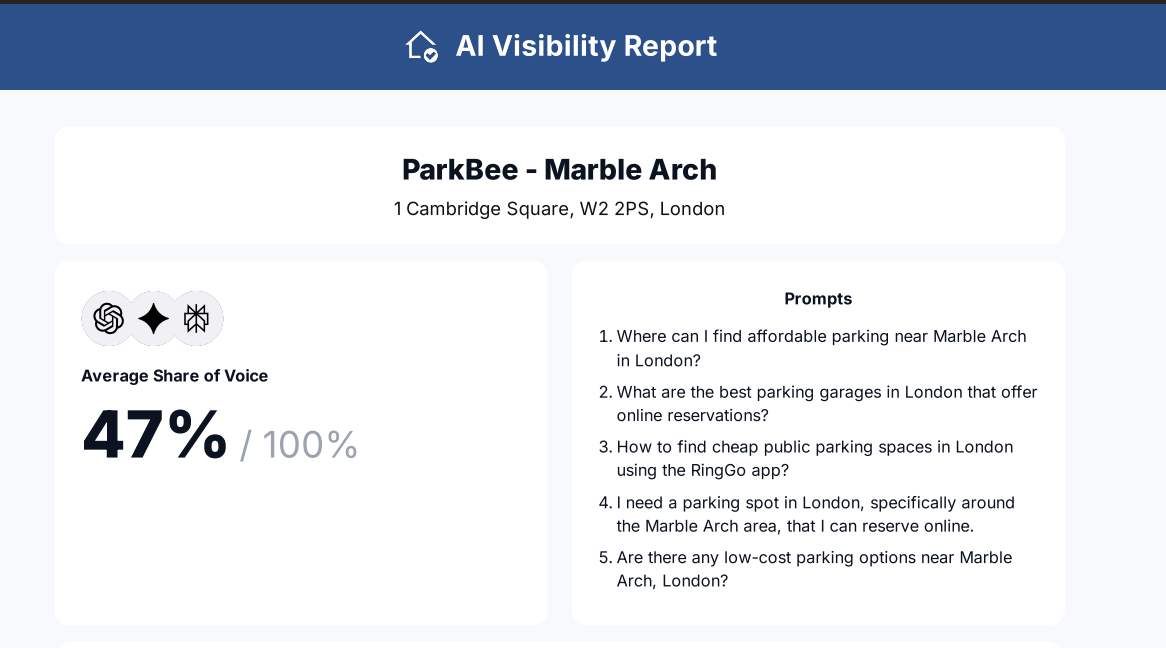
Rankings can go up while calls and clicks go down. Whether that is caused by changes in customers' journeys, new SERPs with AI Overviews, growing monetizing and space for ads, or demand shifting depends on the country, sector and customer, and with all the changes in Local SEO, varies over time..
One thing is clear though. AI answers are where a growing share of that decision happens. Google reported a billion monthly AI Mode users one year after launch, and AI Overviews now appear on about half of local searches in the US. Those AI answers name fewer businesses and rarely send the click: in Nozzle's data across 15 million local queries, only 23% of desktop AI Overviews and 8% on mobile showed a cited URL. If you're not in the answer, you're not in the shortlist.
A Map Pack rank tracker still matters, and GMBapi's Local Rank Tracker covers it. A (Local) LLM rank tracker covers the part of the journey your rank report can't see.
What an LLM rank tracker measures
A ranking in an AI answer isn't a blue link in a logical order. It's a sentence. GMBapi turns those sentences into numbers you can track, compare, and report on, for every AI assistant separately and for all of them combined.
Visibility
The share of AI answers that mention your brand. 60% means you're named in 6 of every 10 answers.
Average position
Where you appear in the answer when you're mentioned. 1 means you're named first.
Brand mentions
The number of AI answers that mention you.
Sentiment
Whether each answer describes you positively, neutrally, or negatively.
Rank
Your position among the competitors AI names, by visibility.
Citations
The websites and pages the AI uses as sources, and how often.
Local AI visibility is hyper-local
AI doesn't give one answer per country. It gives one per neighborhood. When Malte Landwehr of Peec AI ran the same lawyer prompts dozens of times per location in ChatGPT, results for New York and Chicago barely overlapped (rank correlation 0.1). Two Brooklyn neighborhoods two miles apart scored 0.6. Even two spots a 15-minute walk apart only reached 0.8. OpenAI confirms that ChatGPT uses your approximate location for local results. But ChatGPT does not have Google's level of access to critical elements like opening times, reviews and user location. Critical elements for local recommendations.
The bar is high, too. ChatGPT recommends only 1.2% of locations, against 35.9% visibility in the Google 3-pack. For each of the local AI surfaces there are usually wildly different local results. ChatGPT Maps show different local businesses versus their text results, and Ask Maps, Gemini, AI Overview and AI Mode, will recommend different local businesses as they use different sources and algorithms to answer user’s questions. A national AI visibility brand score hides all of that, which is why GMBapi tracks two levels side by side on the same brand across all locally relevant surfaces.
Brand Visibility at country level
Brand Visibility tracks how AI talks about your brand as a whole in a country. It's the view for brand-level questions: who's the most reliable provider, how you compare with a named rival, and what AI says about your pricing or service.
Location Visibility at city level
Location Visibility is the local LLM tracker. It tracks every physical location separately, at city level, with prompts built from each location's Google Business Profile: name, address, and coordinates. That's the Google-first approach we use across GMBapi, with your GBP profile as the source of truth, so the data you already maintain powers your AI tracking too.
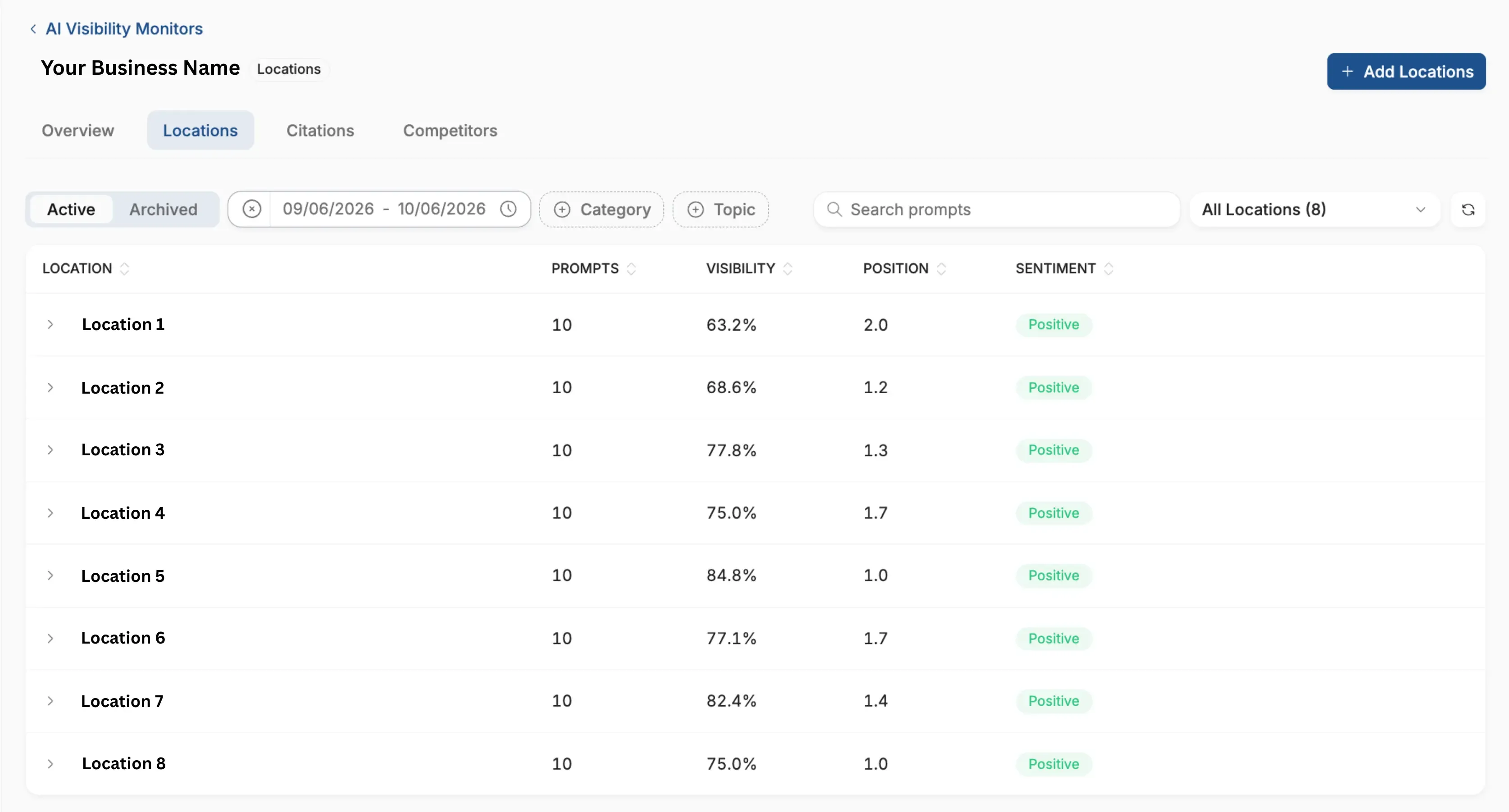
The All Locations view rolls everything up into one network-wide number. One click drills down into a single branch. In one four-location network we track, the overall visibility score was 49%, but individual branches ranged from 28% to 59%. A single average would never show you that.
Every AI assistant reads different sources
The same question gets different answers in ChatGPT and Google, because each assistant reads a different part of the web. That's why every metric in GMBapi can be filtered per assistant, and why one model's score tells you very little on its own.
Google AI Overviews and AI Mode
Draw on Google's own data first, mostly Business Profiles, followed by YouTube (18% of AI Overview citations) and Reddit. Delivery apps, or external review sites barely appear.
ChatGPT
Builds its local answers from Yelp, potentially some scraped Maps data, Bing, editorial "best of" lists, delivery apps, and review sites. In the UK, Yell shows up in almost every category. Other industry or nation specific directories are used heavily elsewhere. Google reviews don't appear at all.
Gemini
Works from Google Maps data, which shows in accuracy: it usually measures a very high profile accuracy against ChatGPT and Perplexity.
👉 Keep your Google Business Profile fresh and you improve most of Google's AI surfaces at once. ChatGPT needs work off Google: the directories, review sites, and editorial lists it actually reads. The citations report shows you which ones, per assistant and per location to power local recommendations.
Setup takes a few minutes, not a project
Most AI tracking tools hand you an empty prompt box. GMBapi writes the first set for you.
- Auto-generated prompts: created from your brand, website, and market, or from each location's profile.
- Custom prompts: write your own and organize them into topics and categories.
- Four prompt categories: General, Organic search, Brand sentiment, and Competitor comparison. Each answers a different question about how AI sees you.
- Your cadence: daily, weekly, or monthly per monitor. Daily suits testing a content change fast. Monthly suits a minimalist approach to Local AI visibility reporting. One or two weekly scans is a nice compromise.
- Pick locations from your account: choose from the Google Business Profile locations already in the segment. Add or disable locations at any time without affecting the others.
- Setup runs in the background: it usually takes a few minutes, with status shown per monitor and per location. You get a notification when the first results are ready.
Built for the way you work
For agencies: AI visibility reporting under your own brand
Clients now ask why ChatGPT recommends their competitor. Without data, that's an awkward conversation. With GMBapi, it's a report, and a list of billable fixes.
See every brand and location monitor in one view, with visibility, position, citations, and trend lines on each card.
Use the competitor filter for a clean head-to-head against the one or two rivals that matter, and toggle chart lines on or off for a client-ready screenshot.
Turn the citations report into an outreach and listings plan: hide your client's and competitors' domains and you're left with the listicles, review sites, directories, and news articles AI trusts.
Run it all under your own logo and brand colors. White-label is free for agencies, self-serve in settings, with no minimum locations or spend.
For multi-location brands: one network view, with an early warning for every branch
Leadership wants one number to track. Local teams need to know what to fix. GMBapi gives you both.
- The overview shows your top- and low-performing locations, so you know where to spend time first.
- Citations with a high Locations count affect many branches at once. Fix one source and you lift the whole network.
- Drill into a single city to find the local rivals that never show up in a national view. Find your outliers and understand what is driving that.
- Sort prompts by negative sentiment to catch the AI answers that hurt your reputation, before they cost you customers.
For small business owners: see who AI recommends instead of you
When someone asks AI for the best option nearby, there's room for only a few names. GMBapi shows whether yours is one of them.
- See the exact answer AI gives for the questions your customers ask, and which competitor it names when it doesn't name you.
- Find the local sources AI relies on for your city, like city guides, local directories, and local news, so you know where getting listed makes a difference.
- Run a monthly monitor and check in once a month. No daily dashboards required. Change the prompts to make them locally relevant so you can use the free version to track AI visibility.
For API partners and developers: skip building the plumbing
Running hundreds of prompts across five AI assistants, then parsing mentions, aliases, positions, and citations per location, is a lot of plumbing to build and maintain. Buying it is faster, and often cheaper once you count the maintenance.
- Structured visibility, position, sentiment, competitor, and citation data per brand and per location.
- We are working on making AI Visibility data available via the Partner API and via MCP.
Citations show you where to get listed
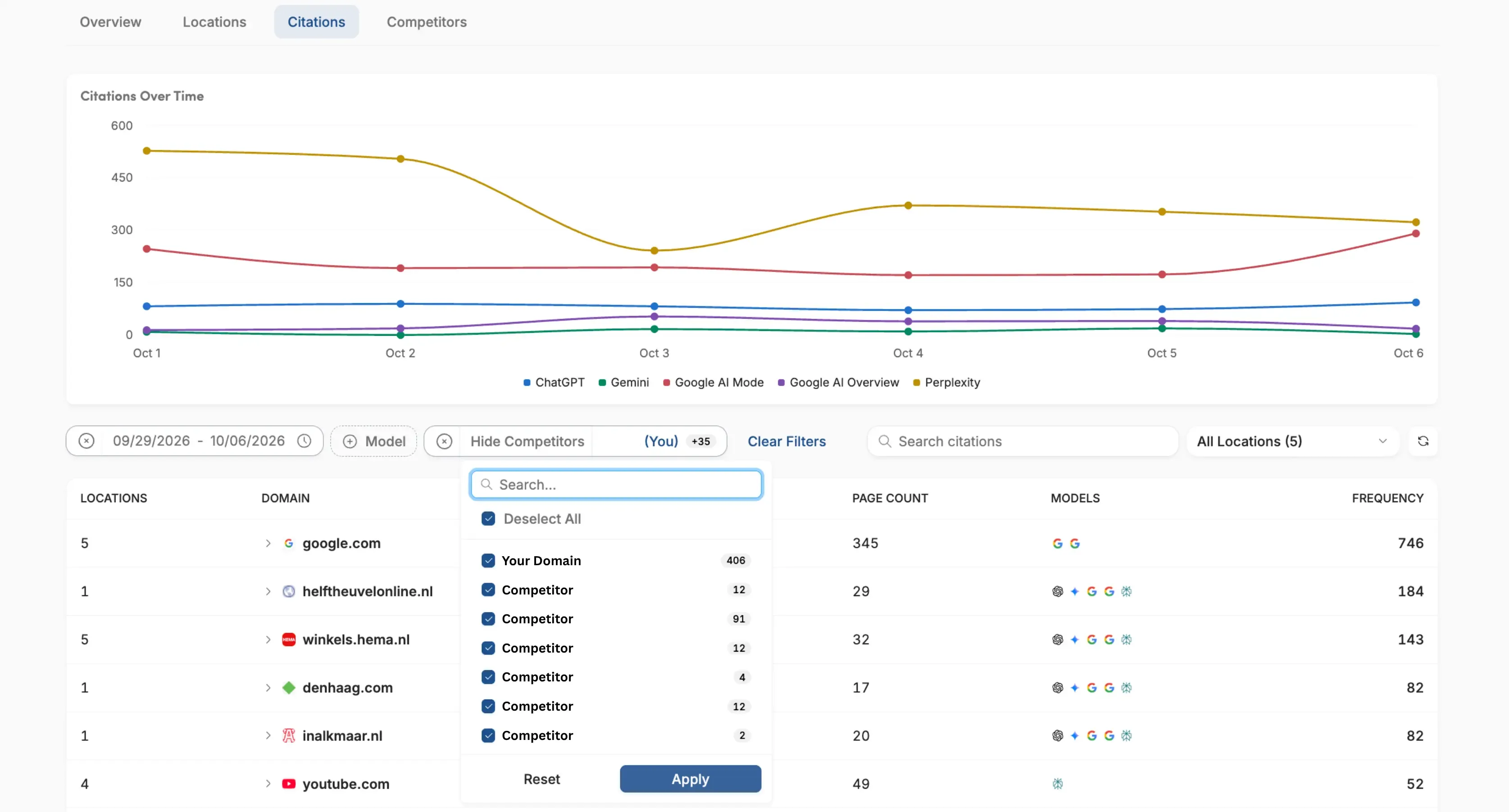
AI doesn't make things up from nowhere. It repeats sources. The citations report shows which websites and pages each assistant cites, how often, and for how many of your locations.
- Filter per model: each AI pulls from different websites, so you see where to get listed to show up in ChatGPT versus Perplexity versus Google AI.
- Hide your own and competitors' domains: what's left are the third-party pages AI trusts. Combine it with a model filter, for example "ChatGPT, excluding us and competitors", and you see exactly which articles to get featured in.
- Expand to pages: see the exact cited URLs, not just the domain, so outreach targets the specific article or listing.
- Track over time: see which sources are rising or falling, and confirm whether a new listing or article starts getting cited.
Every prompt points to a next step
Raw AI answers are noisy. Sorted properly, they become a task list.
Sort by lowest visibility to find the questions where you're invisible. Those are your biggest opportunities.
Filter by topic, like pricing, emergency repairs, or reviews, to see which themes you own and which you lose to competitors.
Open any prompt to read the full AI response for every model and date, with your brand and competitors highlighted in the text, a competitor ranking for that prompt, and the pages each model cited.
Compare before and after with the date range. If you launched a new page or listing last month, you'll see whether the answer changed.
Competitors are found for you
You don't need to know who AI recommends before you start. GMBapi detects competitors automatically from the AI answers and ranks them by visibility, position, and mentions, with your own brand marked "You".
Add your own competitors by website, one at a time or in bulk.
Add competitor aliases so every mention gets counted, however the AI words it.
Add brand aliases for abbreviations, old names, and sub-brands, so your own visibility isn't under-counted. Location monitors can manage aliases per location.
Mark a detected "competitor" as your own brand when it's actually one of your sub-brands.
What else we can do: fix the sources AI reads
Tracking shows you the gap. Closing it means changing what AI reads about you. ChatGPT doesn't rely on one local database: it pieces a business together from maps data (Apple and Bing), your website and its structured data, global vertical platforms like Tripadvisor and Yelp, country-specific directories, and community signals like reviews and photos. GMBapi already manages most of those sources by syncing its citation product to your Google Business Profile. So an element of the fix for a low AI visibility score sits in the same platform as the score.
Citations: the same facts everywhere AI looks
AI picks up changes to listings fast. Andrew Shotland's team found a service phrase customers searched for that was missing from a client's Business Profile. They added it to the description and pushed it to 20 citations, and AI Overview visibility rose across 60 tracked prompts and 20 locations within three to four days.
GMBapi Citation Software does that kind of update at scale. It publishes to Google first, then syncs your name, address, phone, and photos across maps, navigation apps, and 70+ directories, depending on the market (for example 79 in the US, 56 in the UK, and 130 in Germany). The network includes Apple Maps, Bing, and the data feeds AI assistants use, and third-party edits are flagged and corrected automatically. Yell (UK) and Yelp are examples of citation destinations, but there are many more country specific ones..
Local schema: structured facts AI can read
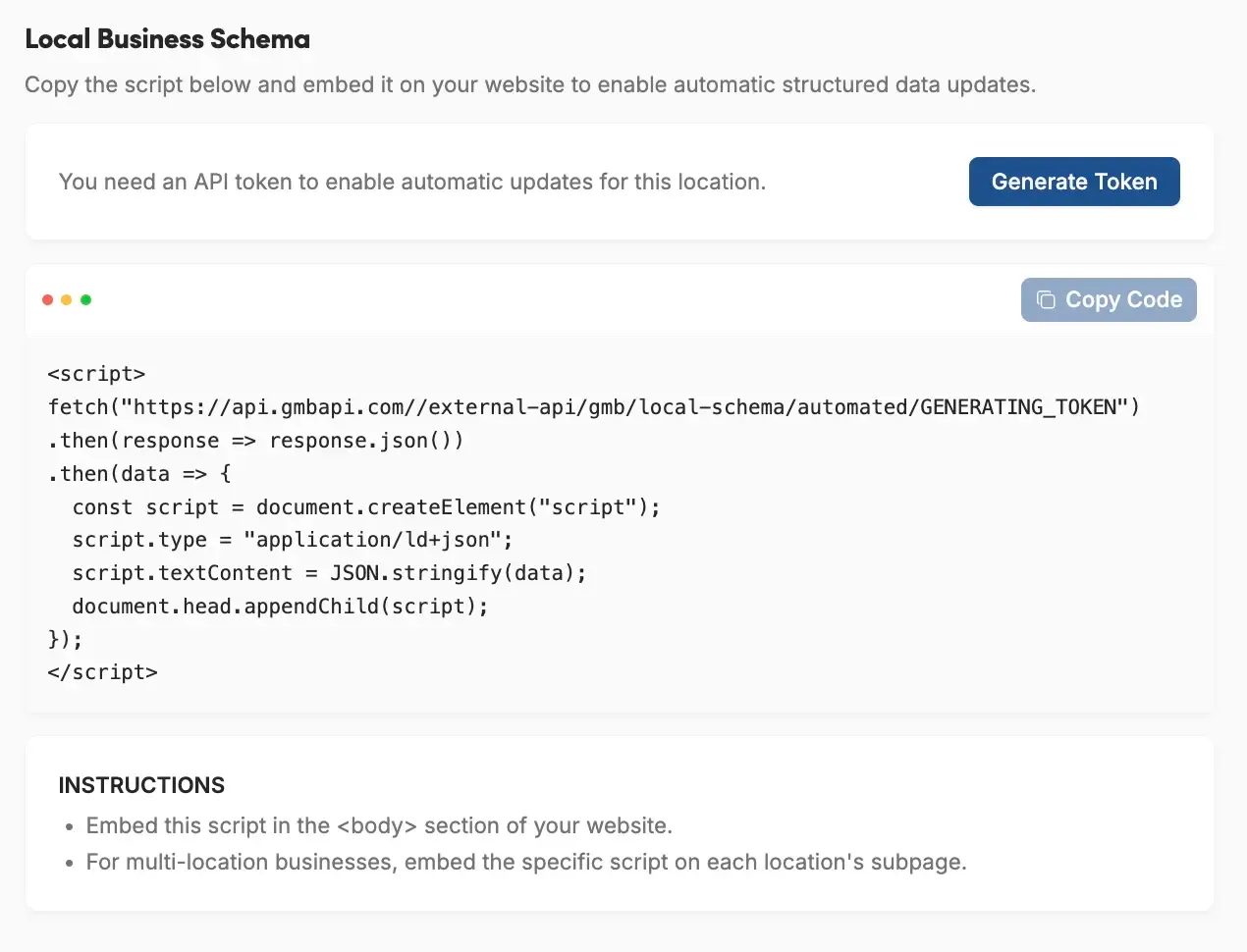
Your own website is still the most authoritative source for current information, and structured data is the clearest way to say it. LocalBusiness schema tells AI assistants, in a format they don't have to interpret, what each location is, where it is, when it's open, and what it offers.
GMBapi generates LocalBusiness structured data for every location from its Google Business Profile, so your schema on your local landing pages always matches your profile. When you update hours or services in GMBapi, the markup follows.
Local websites: a first-party page for every location
A national homepage can't answer a neighborhood question. A local page can. GMBapi's store locator and local landing pages give every location its own first-party page, built on the same Google Business Profile data, so the facts on your site match the facts on Google, in the directories, and in the AI answer.
No website at all is a bigger gap still. Coming soon: GMBapi will create a website straight from your Google Business Profile, for businesses that don't have one yet. For larger multi location businesses, a store locator and local landing page setup are crucial elements of the Local AI visibility puzzle.
Track first, then fix one source at a time. Set a daily monitor while you make a change, then use the date range to compare the week before and the week after. That's how you find out which fixes AI actually picks up.
Why GMBapi?
Now is the best time to start tracking and reporting on your Google Business Profiles. Save time, and start optimising your local presence more effectively with our local SEO software.
Low Pricing
The lowest pricing and price matching if you find a cheaper alternative
Full Functionality
Unlimited access to posting content, multi-lingual AI responses to reviews, and adding additional users
Growth Opportunities
Include service hours, citations, local landing page optimisation, a Store Locator, or Apple Business Connect



Frequently Asked Questions
Google Gemini has its own grounding API, and open-source research from HuggingFace and Dejan SEO offers similar grounding prediction tools.
Local LLM Tracking is software that measures how visible your business locations are in AI-powered search engines such as ChatGPT, Google Gemini, and Perplexity. It helps you understand when and how your business appears in AI search answers and which sources influence that visibility.
AI search is becoming a key discovery channel. LLMs often provide direct answers instead of just a list of links. If your business isn’t mentioned in those answers, you risk losing potential customers to competitors who are.
Traditional SEO focuses on ranking in Google’s local pack and organic results. AI search blends real-time web grounding with model-generated answers. That means freshness, authority, and citations across multiple platforms matter more than just keyword rankings.
Grounding is the process where an LLM decides whether to answer from its training data or fetch updated information from the web. When an LLM grounds a query, your optimised content and citations can be pulled into its response.
- Keep your business data, reviews, and content fresh.
- Build consistent citations across platforms like Google Business Profile, Apple Business Connect, and local directories.
- Use Local LLM Tracking to identify which sources AI search engines rely on and focus your outreach there.
Our tool currently tracks visibility in ChatGPT, Google Gemini, and Perplexity, the three largest LLMs actively shaping AI search discovery.
Our platform generates brand name variations and locally relevant prompts, then scans LLMs to see how often your business is mentioned. It reports visibility scores, top sources cited, and Share of Voice across multiple models.
Yes. The tool can run scans across all your business locations, showing which sites are most visible in AI search and highlighting citation opportunities at scale.
Absolutely. Google’s core local pack and organic results still influence a huge volume of traffic. The winning strategy is dual optimisation: continue to strengthen traditional SEO while building visibility in AI-driven answers.
Local marketing managers, SEO specialists, and SaaS buyers are looking to future-proof their local SEO strategy. Early adopters gain a competitive edge by optimising where AI search is headed, not just where it has been.
No. The tool is built for marketers and SEO managers. Results are provided in clear reports (PDF and Excel), with direct links to the sources that AI engines used.
Start growing with GMBapi
Leverage AI to manage reviews, bulk publish content while ensuring consistency across all your local platforms. Stay ahead by monitoring competitors & showcasing what makes you stand out.
Our Transparent Pricing
EXPLORE PLANSHow Our Clients Keep Winning
SUCCESS STORIESHave any questions?
Feel free to contact us!
Trusted By

%20--%3e%3csvg%20version='1.1'%20id='Layer_1'%20xmlns='http://www.w3.org/2000/svg'%20xmlns:xlink='http://www.w3.org/1999/xlink'%20x='0px'%20y='0px'%20viewBox='0%200%20229%2033'%20style='enable-background:new%200%200%20229%2033;'%20xml:space='preserve'%3e%3cstyle%20type='text/css'%3e%20.st0{fill-rule:evenodd;clip-rule:evenodd;fill:%23ffffff;}%20.st1{fill:%23ffffff;}%20%3c/style%3e%3cg%3e%3cg%3e%3cpath%20class='st0'%20d='M166.4,6c0.1-2.2-1.7-3.2-3.7-2.8c-1.8,0.3-3.6,1.9-5,3.4v0c-0.5,0.6-1,0-1,0l0,0c-1.4-1.5-3.2-3.1-5-3.4%20c-1.9-0.4-3.7,0.6-3.7,2.8c0.1,3.9,4.8,3.9,7.7,2.4c-2.1,1.9-4.3,4.4-6.2,3.4c0,0,0,0-0.1-0.1c0.4-0.1,0.6-0.4,0.6-0.8%20c0-0.4-0.4-0.7-0.8-0.7c-0.4,0-0.7,0.4-0.7,0.9c0,0.2,0.1,0.3,0.2,0.4h0c2.7,2.9,6.3-1.5,8.3-3.8c0,0,0.1,0,0.1,0c0,0,0.1,0,0.1,0%20c2,2.3,5.6,6.8,8.3,3.9h0c0.1-0.1,0.2-0.3,0.2-0.4c0-0.4-0.3-0.8-0.7-0.9c-0.4,0-0.8,0.3-0.8,0.7c0,0.4,0.2,0.7,0.6,0.8%20c0,0-0.1,0.1-0.1,0.1c-1.9,1-4.1-1.4-6.2-3.4C161.6,9.9,166.3,9.9,166.4,6z%20M150.6,7.5c-3.1-2,0.5-6.8,6.3-0.2%20C156.9,7.3,153.7,9.4,150.6,7.5z%20M157.6,7.3c5.7-6.6,9.3-1.7,6.3,0.2C160.8,9.4,157.6,7.3,157.6,7.3z'/%3e%3c/g%3e%3cg%3e%3cpath%20class='st1'%20d='M0,0.7V0h3.7v17.9h0.1c1.1-2.1,3.4-4.5,6.6-4.5c4.7,0,6,2.4,6,5v14.1h-3.7V17.3c0-2.4-1.2-3.2-2.6-3.2%20c-3.7,0-5.6,3.7-6.4,5.2v13.2H0V0.7z'/%3e%3cpath%20class='st1'%20d='M24.7,14.1v-0.7h3.7v15.8c0,1.9,1.1,3.1,2.7,3.1c3.1,0,5.8-3.5,5.8-6.8V14.1v-0.7h3.7v19.1H37v-4h-0.1%20c-0.4,1-2.2,4.6-6.2,4.6c-4.4,0-6-2.3-6-4.9V14.1z'/%3e%3cpath%20class='st1'%20d='M49,15.1v-1.7h3.7v4.5h0.1c1.1-2.1,3.3-4.5,6.6-4.5c4.7,0,6,2.4,6,5v14.1h-3.7V17.3c0-2.4-1.2-3.2-2.6-3.2%20c-3.7,0-5.6,3.7-6.4,5.2v13.2H49V15.1z'/%3e%3c/g%3e%3cpolygon%20class='st1'%20points='72.1,0%2075.8,0%2075.8,24.6%2086.4,14.4%2087.7,14.4%2080.1,21.5%2088.9,32.5%2084.1,32.5%2077.4,24.1%2075.8,25.6%2075.8,32.5%2072.1,32.5%20'/%3e%3cg%3e%3cpath%20class='st1'%20d='M96.2,25.6c0,3.1,0.4,6.7,4.5,6.7c3.7,0,6.4-2.5,7-6.1h0.7c-0.7,4.1-3.7,6.8-7.8,6.8c-5.2,0-8.8-4-8.8-9.8%20c0-4.3,3.4-9.8,8.2-9.8c5.2,0,7.9,5.8,7.9,7.7c0,0.3-0.1,0.4-0.4,0.4H96.2V25.6z%20M103.9,19.5c0-2.8-0.8-5.4-3.7-5.4%20c-3.1,0-4,2.6-4,5.4v1.2h7.4c0.2,0,0.3-0.1,0.3-0.3V19.5z'/%3e%3cpath%20class='st1'%20d='M113.6,32.5V14.1v-0.7h3.7v4.3h0.1c1.2-2.2,3-4.3,6.3-4.3c2.8,0,5.6,0.8,6,4.7h0.1c0.9-2.5,3.1-4.8,6.4-4.7%20c4.5,0,6,2.6,6,5.4v13.7h-3.7V18c0-3.2-1.4-3.9-3.1-3.9c-2.6,0-4.8,2.8-5.7,5.9v12.5H126V17.1c0-2.2-1.1-3-2.9-3%20c-2.6,0-4.6,2.1-5.9,5.2v13.2H113.6z'/%3e%3cpath%20class='st1'%20d='M157.3,13.4c5.7,0,9.3,4.7,9.3,9.8c0,5.1-3.7,9.8-9.3,9.8c-5.7,0-9.3-4.7-9.3-9.8%20C147.9,18.1,151.6,13.4,157.3,13.4%20M162.4,21.5c0-3.8-0.2-7.4-5.1-7.4c-4.9,0-5.1,3.5-5.1,7.4v3.4c0,3.8,0.2,7.4,5.1,7.4%20c4.9,0,5.1-3.5,5.1-7.4V21.5z'/%3e%3c/g%3e%3cpolygon%20class='st1'%20points='172.6,0.7%20172.6,0%20176.3,0%20176.3,32.5%20172.6,32.5%20'/%3e%3cpolygon%20class='st1'%20points='184.8,0.7%20184.8,0%20188.5,0%20188.5,32.5%20184.8,32.5%20'/%3e%3cg%3e%3cpath%20class='st1'%20d='M198.7,25.6c0,3.1,0.4,6.7,4.5,6.7c3.7,0,6.4-2.5,7-6.1h0.7c-0.7,4.1-3.7,6.8-7.8,6.8c-5.2,0-8.8-4-8.8-9.8%20c0-4.3,3.4-9.8,8.2-9.8c5.2,0,7.9,5.8,7.9,7.7c0,0.3-0.1,0.4-0.4,0.4h-11.5V25.6z%20M206.4,19.5c0-2.8-0.7-5.4-3.7-5.4%20c-3.1,0-4,2.6-4,5.4v1.2h7.4c0.2,0,0.3-0.1,0.3-0.3V19.5z'/%3e%3cpath%20class='st1'%20d='M216.6,15.1v-1.7h3.7v5.2h0.1c0.5-2,2.1-5.2,5.7-5.2c1.6,0,2.9,1.1,2.9,2.6c0,1.1-0.7,2.1-2,2.1%20c-1.5,0-1.9-0.8-1.9-1.9c0-1,0.5-1.6,1-1.9c-0.2-0.1-0.4-0.1-0.6-0.1c-1.8,0-5.1,2.9-5.1,8.6v9.8h-3.7V15.1z'/%3e%3c/g%3e%3c/g%3e%3c/svg%3e)

'%3e%3c/path%3e%3cpath%20d='M27.28,30.32H22.72V18.87a2.26,2.26,0,0,1,.67-1.62l6.75-6.75a2.25,2.25,0,0,1,1.62-.67H43.22v4.56H30.69a3.42,3.42,0,0,0-3.42,3.42Z'%20transform='translate(0%20-0.18)'%3e%3c/path%3e%3cpath%20d='M63.8,9.82h3.52V13h.08a6.24,6.24,0,0,1,5.34-3.66,10.69,10.69,0,0,1,2.49.28V13a5.6,5.6,0,0,0-2.09-.36c-3.38,0-5.59,3.22-5.59,8.37v9.33H63.8Z'%20transform='translate(0%20-0.18)'%3e%3c/path%3e%3cpath%20d='M179.24,22.35c0,3.09-2,5.44-5.7,5.44-1.72,0-3.81-1.18-3.81-3.36,0-3.65,5.06-4,7.1-4,.8,0,1.6.08,2.41.08Zm-11-7.87a9.52,9.52,0,0,1,5.94-2.13c3.77,0,5.05,1.84,5.05,5.38-1.48-.08-2.53-.08-4-.08-3.89,0-9.52,1.6-9.52,6.75,0,4.5,3.1,6.42,7.51,6.42a7.6,7.6,0,0,0,6.34-3.11h.08v2.61H183V17.79c0-5.6-2.36-8.47-8.21-8.47A13.1,13.1,0,0,0,168,11.24Z'%20transform='translate(0%20-0.18)'%3e%3c/path%3e%3cpath%20d='M88,22.35c0,3.09-2,5.44-5.7,5.44-1.73,0-3.81-1.18-3.81-3.36,0-3.65,5.06-4,7.1-4,.8,0,1.6.08,2.41.08ZM77,14.48A9.52,9.52,0,0,1,83,12.35c3.77,0,5.06,1.84,5.06,5.38-1.48-.08-2.53-.08-4-.08-3.89,0-9.52,1.6-9.52,6.75,0,4.5,3.1,6.42,7.51,6.42a7.6,7.6,0,0,0,6.34-3.11h.08v2.61H91.8V17.79c0-5.6-2.36-8.47-8.21-8.47a13.1,13.1,0,0,0-6.74,1.92Z'%20transform='translate(0%20-0.18)'%3e%3c/path%3e%3cpath%20d='M94.88,9.82h3.64V13h.08a7.39,7.39,0,0,1,6.73-3.72c5.31,0,7.66,3.28,7.66,8.79V30.32h-3.76V19.69c0-4.79-1-7.13-4.35-7.33-4.31,0-6.24,3.47-6.24,8.48v9.48H94.88Z'%20transform='translate(0%20-0.18)'%3e%3c/path%3e%3cpath%20d='M137.55,26.33a10.06,10.06,0,0,0,4.7,1.45c1.72,0,3.85-.73,3.85-2.95,0-3.76-8.87-3.43-8.87-9.21,0-4.27,3.18-6.31,7.23-6.31a15.49,15.49,0,0,1,4.7.81l-.32,3.27a11,11,0,0,0-4-1.05c-1.92,0-3.61.81-3.61,2.51,0,4.2,8.87,3,8.87,9.58,0,4.39-3.5,6.39-7.15,6.39a11.84,11.84,0,0,1-5.62-1.12Z'%20transform='translate(0%20-0.18)'%3e%3c/path%3e%3cpath%20d='M164.48,12.85h-5.43V24.11c0,2.38,1.45,3.67,3.17,3.67a4.65,4.65,0,0,0,2.57-.73v3.2a11.94,11.94,0,0,1-3.21.56c-3.89,0-6.29-1.83-6.29-5.94v-12h-4.62v-3h4.62V5.08l3.76-1.2V9.82h5.43Z'%20transform='translate(0%20-0.18)'%3e%3c/path%3e%3cpath%20d='M189.56,20c-.08-3.76,1.53-7.64,5.62-7.64s6.06,3.92,6.06,7.76c0,3.43-1.77,7.68-6,7.68C191.17,27.79,189.48,23.22,189.56,20ZM201.4,30.32H205V.18h-3.76V12.6h-.08C200,10.72,198,9.32,194.38,9.32c-5.94,0-8.84,4.85-8.84,10.37s2.61,11.13,8.8,11.13a8.22,8.22,0,0,0,7-3.36h.08Z'%20transform='translate(0%20-0.18)'%3e%3c/path%3e%3cpath%20d='M119.57,20c-.08-3.76,1.53-7.64,5.62-7.64s6.06,3.92,6.06,7.76c0,3.43-1.77,7.68-6,7.68C121.17,27.79,119.48,23.22,119.57,20Zm11.84,10.33H135V.18h-3.76V12.6h-.08C130,10.72,128,9.32,124.38,9.32c-5.94,0-8.84,4.85-8.84,10.37s2.61,11.13,8.8,11.13a8.22,8.22,0,0,0,7-3.36h.08Z'%20transform='translate(0%20-0.18)'%3e%3c/path%3e%3c/svg%3e)