 Michel van Luijtelaar
WWDC 2026 confirmed what local SEO practitioners have been watching for months. Here’s what it means in practice.
Apple held its annual developer conference yesterday. Most of the coverage is about the new Siri AI and Liquid Glass tweaks. But there’s a quieter story that matters more to local businesses. Apple Maps is becoming a primary data source for an AI assistant that will be installed on over a billion active devices this autumn.
If your Apple Business listing is incomplete, unverified, or inconsistent with your Google Business Profile, that’s a real problem starting from iOS 27’s public release.
The Apple ecosystem is a closed loop. Apple Business is the only way in.
This is the part most businesses miss entirely.
Google is an open system. Your business data flows in from dozens of sources: your website, third-party directories or citation networks, social media accounts, rich media such as photos, uploaded videos and/or YouTube, and user edits (Google confirmed 500 million Local Guides in July 2025). Google triangulates all of it.
Apple works differently. Apple Business is Apple’s platform that allows businesses to claim and manage how their locations appear on Apple Maps and control how they show up across other Apple applications and features. Accuracy, clarity, and brand consistency are central to how Apple displays business information. There is no back door. There is no other data source Apple prioritises. If you haven’t claimed and actively managed your Apple Business listing, Apple decides how your brand looks across its entire ecosystem, and you have no say in it. PinMeTo
At WWDC 2026, Apple demonstrated exactly how deep that ecosystem goes. A single business profile now surfaces across Apple Maps, Siri, CarPlay, Mail, Wallet, Spotlight search, Messages location shares, and the new Vision Pro spatial maps. The airline example shown during the keynote illustrated this precisely: when a customer receives a flight confirmation email, Apple pulls the airline’s brand, logo, and details directly from Apple Business and displays them consistently across the booking email, the Maps route to the airport, the Wallet boarding pass, and any Siri query about the flight. One source. Every surface. All of it is controlled through Apple Business.
That’s not a feature. That’s a fundamental shift in how brand identity works inside the Apple ecosystem.
The Place Card, Showcases, and Action Links all cross-channel surfaces that pull from the same Apple Business profile data, so a brand identity established once propagates everywhere across the Apple ecosystem.
Get your Apple Business listing right, and your brand is consistent everywhere Apple touches a customer. Get it wrong, or ignore it entirely, and Apple fills in the gaps itself.
What actually changed at WWDC 2026
Apple introduced Siri AI, a new version of its digital assistant that integrates deeply with its updated Apple Intelligence system, built in collaboration with Google’s Gemini models. The assistant is designed to be more conversational, context-aware, and capable of executing tasks across apps and devices. Business Standard
From a customer’s spoken question to a vendor call placed by Siri, multiple friction points collapse into one. Voice becomes the interface, AI becomes the recommender, and the business with the cleanest, most consistent data across every platform the model touches becomes the default name on the screen. Marketing Code
Apple Maps ads are also rolling out in summer 2026 in the US and Canada, with sponsored top-of-result placement and inclusion in a new “Suggested Places” section. The paid placement is new. But the businesses that benefit most from Siri AI won’t just be the ones paying for ads. They’ll be the ones with accurate, complete, actively managed listings that give the AI something reliable to work with. MaaS
What you can control through Apple Business
Here’s what sits inside your Apple Business listing, and what Siri AI pulls from when a customer asks for a nearby recommendation:
Place Card
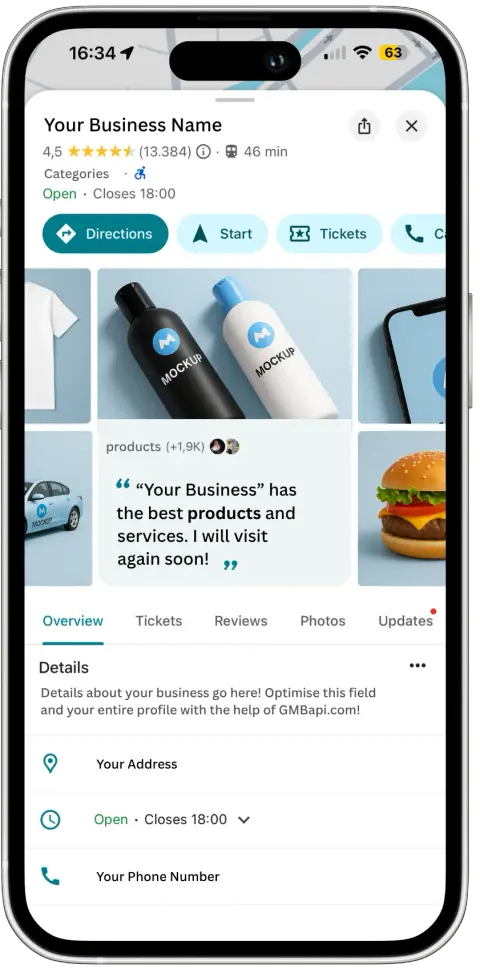
the core listing. Hours, address, phone, website, photos, categories, and attributes. This surfaces in Apple Maps, Siri, Spotlight, the Look Around panel, CarPlay search, Messages location shares, Apple Wallet, and the new Vision Pro spatial maps. Every Apple surface where a customer might encounter your brand.
Showcases
evergreen and seasonal tiles for menus, services, offers, new locations, and announcements. They display inside the place card and influence which businesses surface in category searches. Most businesses aren’t using these. That’s a gap you can close now before Siri AI starts making recommendations at scale.
Action Links
deep links into your booking, ordering, reservations, payment, or loyalty partner. Fewer steps between “Siri found your business” and “customer completed a transaction.”
Reviews
Apple Maps reviews carry less volume than Google but disproportionate weight inside Siri’s recommendation logic. Reply to everyone. The discipline matters more now than it did six months ago.
The competitive gap that won't last
Around 58% of US businesses have not claimed their Apple Business listing, and only 16% actively manage it. Most categories have far lower competitive density on Apple Maps than on Google. Apple Maps is not the biggest channel by raw volume, but it is the channel where competitive density is dramatically lower. MaaS
That gap closes when Siri AI rolls out to a billion devices this autumn. The businesses with their Apple listing in order before then have a head start that’s genuinely hard to recover from.
The Google-first principle still applies
At GMBapi.com, we treat Google as the source of truth and distribute accurate data outward. That logic applies directly here. Your Google Business Profile is the foundation. Get that right, sync it to Apple Business and the wider citation network, and you’re giving Siri AI consistent, trustworthy data across every platform it touches.
A business with accurate data on Google but outdated or unclaimed information on Apple Business is now leaving a visible gap in its brand presence. Siri doesn’t cross-reference. It uses what it finds in Apple’s ecosystem. And the only thing that controls what it finds is your Apple Business listing.
What to do before iOS 27 ships this autumn
- Claim and verify your Apple Business listing. It’s free and the only way to control how your brand appears across Apple’s ecosystem.
- Audit your Place Card. Hours, address, phone, photos, and categories should match your Google Business Profile exactly.
- Add Showcases. Most competitors haven’t. Low effort, real competitive advantage in category searches.
- Reply to Apple Maps reviews. Volume is lower than Google’s, but the weight in Siri’s recommendation logic is higher than most businesses expect.
- Sync your GBP data outward through a citation management tool to keep Apple Business, Bing, Foursquare, and the wider network consistent with your Google source of truth.
iOS 27 ships to the public this autumn
Every Apple device your customers carry is about to get a more capable AI assistant. The question is whether that assistant recommends your business or your competitor’s.
GMBapi.com manages citation syncing to Apple Business
as part of our local citation packages. Your Google Business Profile data is published to Google first, then distributed accurately to Apple Maps and hundreds of other platforms. See citation packages