Three Quarters of EEA Search Impressions Vanished in Four Days. Customers Kept Calling.

Google Business Profile Search impressions in the EEA collapsed in four days. Across roughly 15,000 EEA locations in 24 countries, Mobile Search impressions fell 74%, and Desktop Search fell 71% when we compare 26 September to 4 October with the week of 15 to 21 September. Over the same dates in 2025, Mobile Search rose 4.5%, and Desktop Search dipped 3.6%, so this isn't seasonal. The 10,400 locations we track in the US, the UK, and Switzerland show no break.
Here's the part that matters for your business: customers behaved the same. Calls, website clicks, and direction requests changed by just 2% over the same comparison. Our point of view is clear. This is a change in what Google reports, not a loss of real visibility. And it isn't explained by the new aggregator units alone: insurance agencies, day care centres, and parking garages lost just as much, and they don't get an aggregator unit at all.
It Started in Our Own Dashboards
The first signal was a sharp break in individual profiles. Mobile Search (navy) and Desktop Search (orange) dropped on the same day in profile after profile, while Maps impressions carried on. That's what sent us into the full dataset.
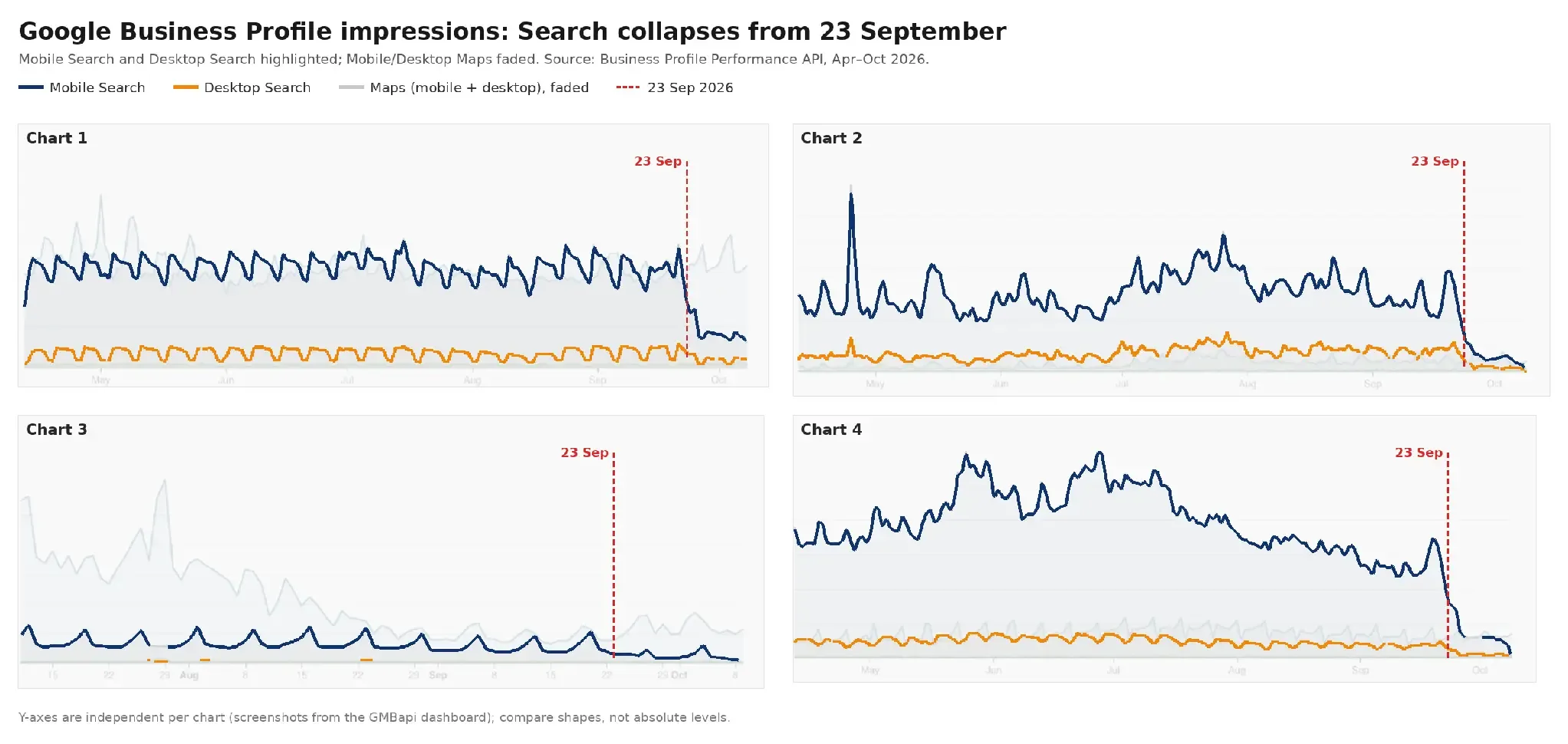
Four EEA Business Profiles in the GMBapi dashboard, April to October 2026. Mobile Search and Desktop Search highlighted, Maps faded.
How to read it: Each panel is one location with its own scale. The red dashed line marks 23 September. In charts 1, 2, and 4, the navy Mobile Search line falls off a cliff on that date. In chart 1 you can also see the faded Maps line carry on above it, which is why we first suspected a shift to Maps. The full dataset later showed that shift doesn't hold across the EEA.
The Drop Started on 23 September, and Only in the EEA
The break is sharp, and it happened in steps. Indexed to 100 for 15 to 21 September, EEA Search impressions slipped to 83 on 22 September, fell to 59 on 23 September, held around 50 on 24 and 25 September, and dropped to about 27 from 26 September onward. They stayed flat at that level through 4 October, the last day in our export.
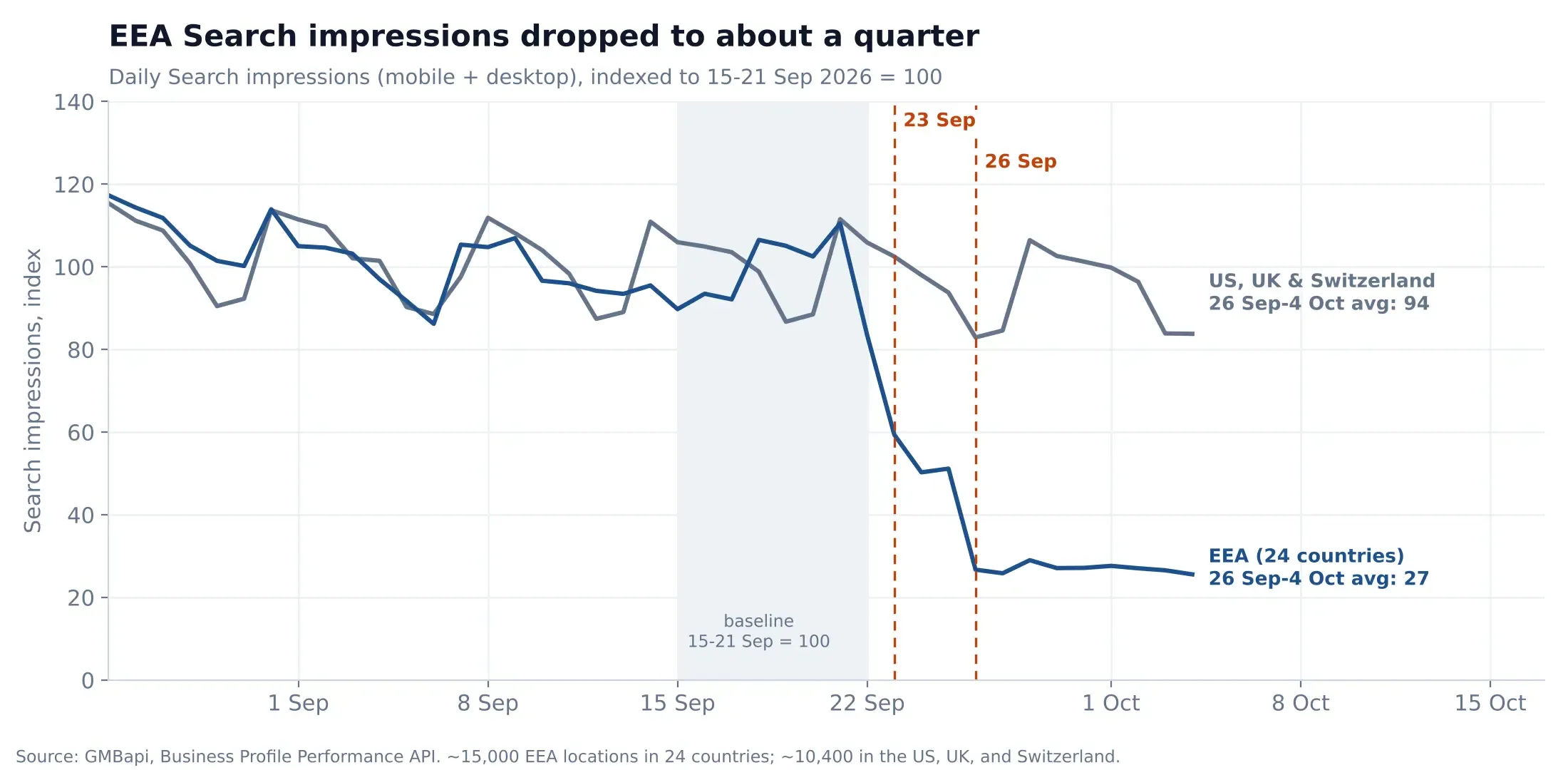
Daily Search impressions, EEA vs. the US, UK, and Switzerland, indexed to 15-21 Sep 2026 = 100.
How to read it: The shaded band is the baseline week. The navy EEA line steps down between the two dashed lines and then runs flat at about a quarter of its old level. The gray line, roughly 10,400 locations outside the EEA, keeps its normal weekday rhythm with no break. That's the control group that rules out a global change.
The calendar puts the drop right at the end of Google's DMA compliance window:
- 23 July 2026: The European Commission fines Google €460 million for favoring its own services in Search and gives it 60 days to comply.
- 8 September 2026: Google rolls out redesigned search results across the EEA, with aggregator units for hotels, flights, trains, and products.
- 18 September 2026: Google extends the aggregator and supplier units to local business searches. Its Actions Center describes these as dining, services such as beauty salons, and things to do, and says the new unit "replaces existing units" on the page.
- 21 to 25 September 2026: The 60-day compliance window closes. Sixty days from 23 July lands on 21 September; a weekly search news roundup puts the deadline at 25 September.
- 22 to 26 September 2026: EEA Search impressions step down in four days, on the same days in every country.
Year Over Year, Search Went From Growth to -73% in a Week
The year-over-year view removes any doubt about seasonality. In the week of 15 to 21 September, EEA Mobile Search impressions per location were 6% higher than on the same days in 2025, and Desktop Search was flat. From 26 September to 4 October, Mobile Search was 73% below last year and Desktop Search 69% below. Customer actions moved from 4% above last year to 4% below.
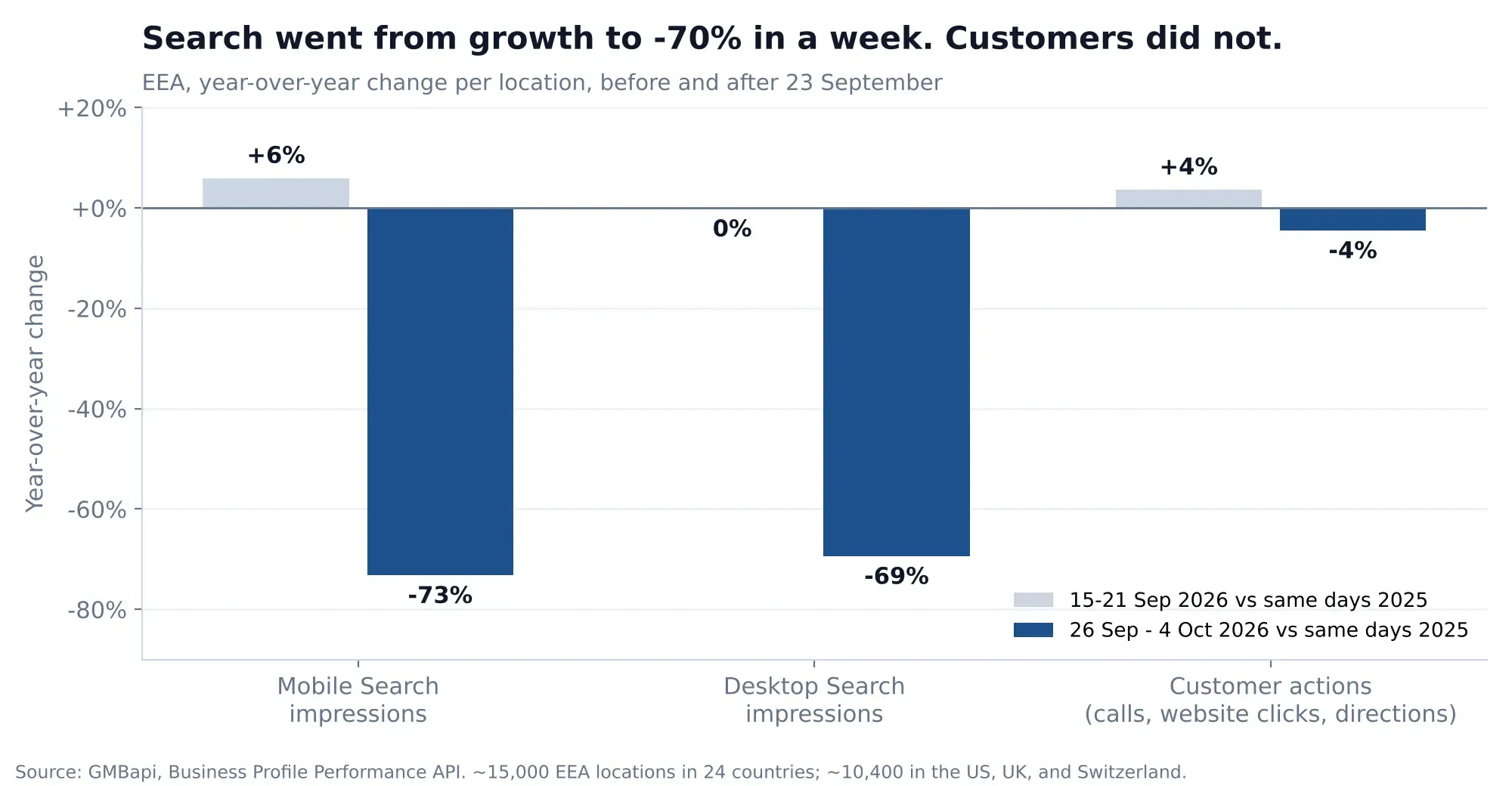
EEA year-over-year change per location, before and after 23 September.
How to read it: Each pair of bars compares the same days in 2026 and 2025. The light bars are the week before the drop, the dark bars the nine days after. Search swings by more than 70 points; customer actions move by about 8.
Every Large EEA Market Broke the Same Way
This isn't one country or one client. The Netherlands, Germany, Italy, France, Belgium, Spain, Austria, Sweden, and Poland all went from between -13% and +29% year over year to between -66% and -73%. Each of them stepped down on the same days, 22 to 26 September.
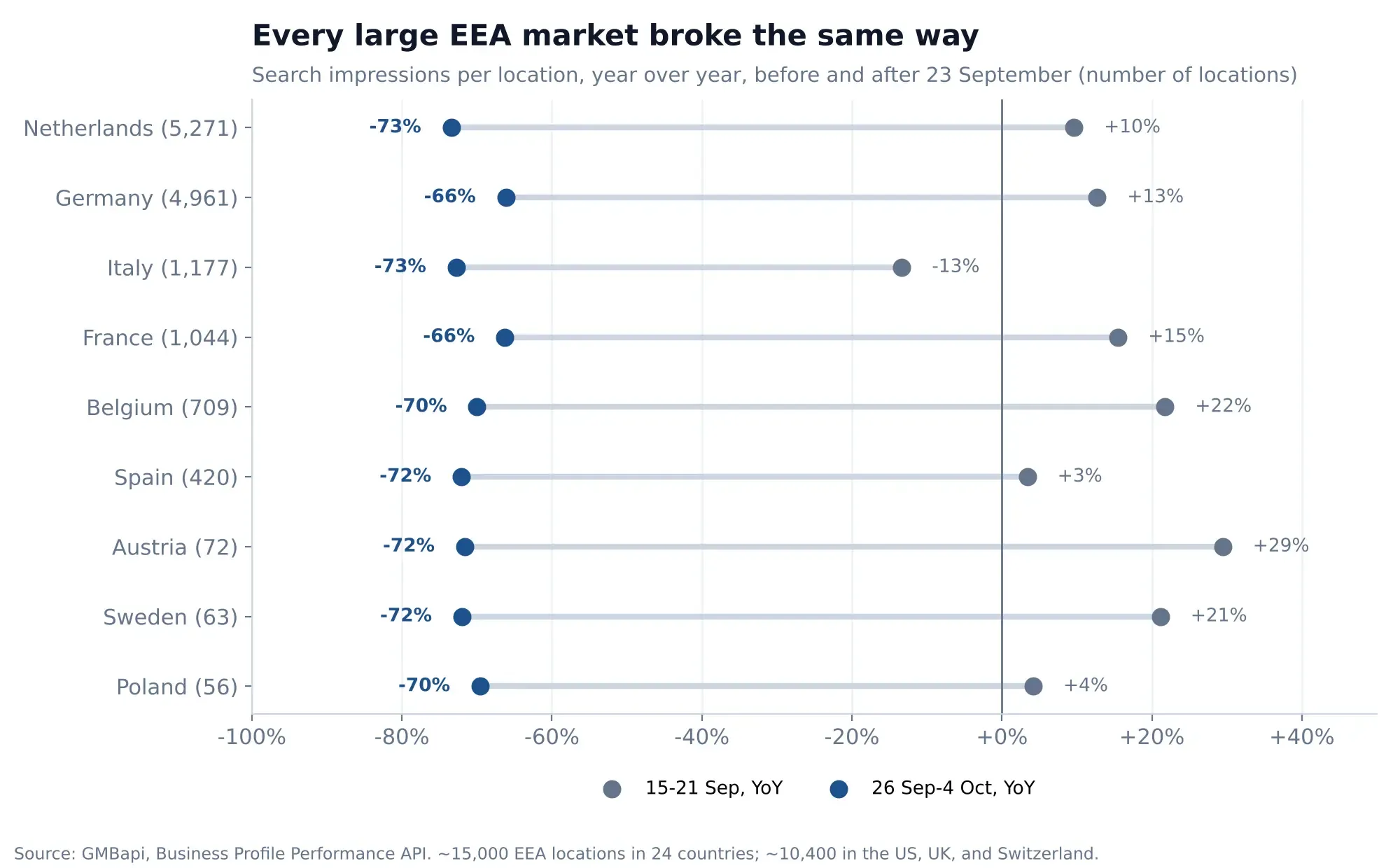
Search impressions per location, year over year, before and after 23 September, by country.
How to read it: The grey dot is each country's year-over-year change in the week before the drop; the blue dot is the change after it. However different the starting points, every market lands in the same narrow band around -70%.
Search Impressions Fell Sharply While Customer Actions Stayed the Same
The impressions disappeared. They didn't move to Maps. EEA profiles lost about 685,000 Search impressions per day. To absorb that, Maps impressions would have needed to rise by roughly 44%. They changed by -1%.
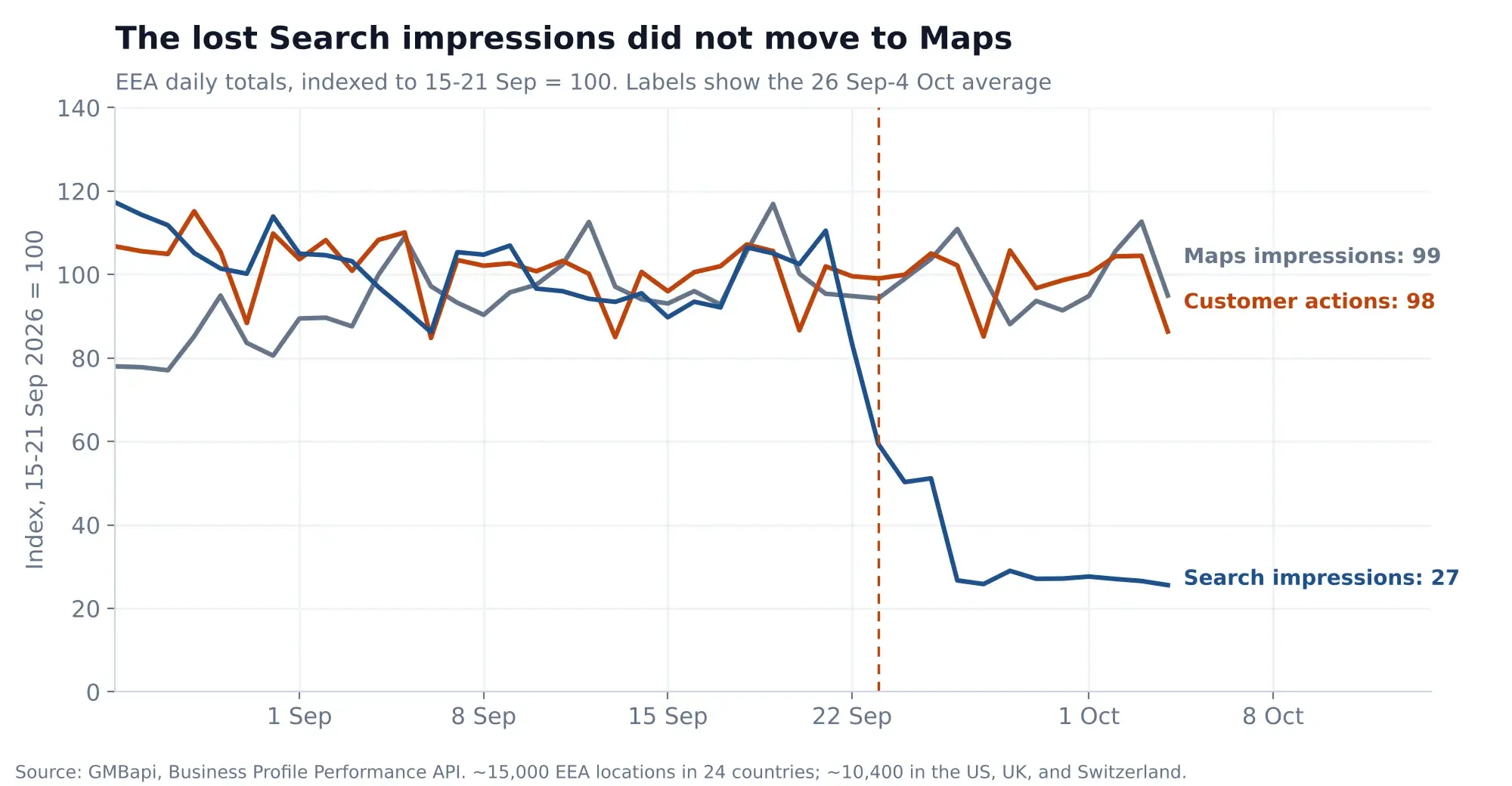
EEA Search impressions, Maps impressions, and customer actions, indexed to 15-21 Sep 2026 = 100.
How to read it: All three lines start at 100 in the baseline week. Search (navy) drops to 27. Maps (grey) and customer actions (orange) keep moving around 100, with their usual weekend dips. If Search impressions had simply been relabeled as Maps impressions, the grey line would have jumped.
Customer actions held up. Calls, website clicks, and direction requests changed by -2% against the week before, so actions per 1,000 total impressions jumped from 73 to 100. The people who contact a business are still finding it.
Key note:
Two details are worth watching. EEA website clicks were 3% lower than the week before, while the same week in 2025 showed a 10% rise. Calls fell too, but they also fell in the US and the UK, so that dip isn't an EEA story. One possible factor is the rapid spread of AI-generated answers: one tracking study saw AI Overviews jump from about 26% to over 80% of branded searches in late September. That's a hypothesis, not a finding.
No Aggregator Unit, Same 70% Drop
Insurance agencies don't get an aggregator unit. They lost 64% of their Search impressions anyway. We looked at all 36 EEA categories with at least 50 locations in our data. Every single one fell by between 45% and 84%, with a median of 73%. Day care centres fell 70%, parking garages 73%, auto repair shops 74%, and cell phone stores 84%. In our spot checks, insurance, day care, and hairdresser searches showed no aggregator unit at all. The two categories where aggregator units are easiest to find, restaurants and hotels, actually sit at the low end of the chart.
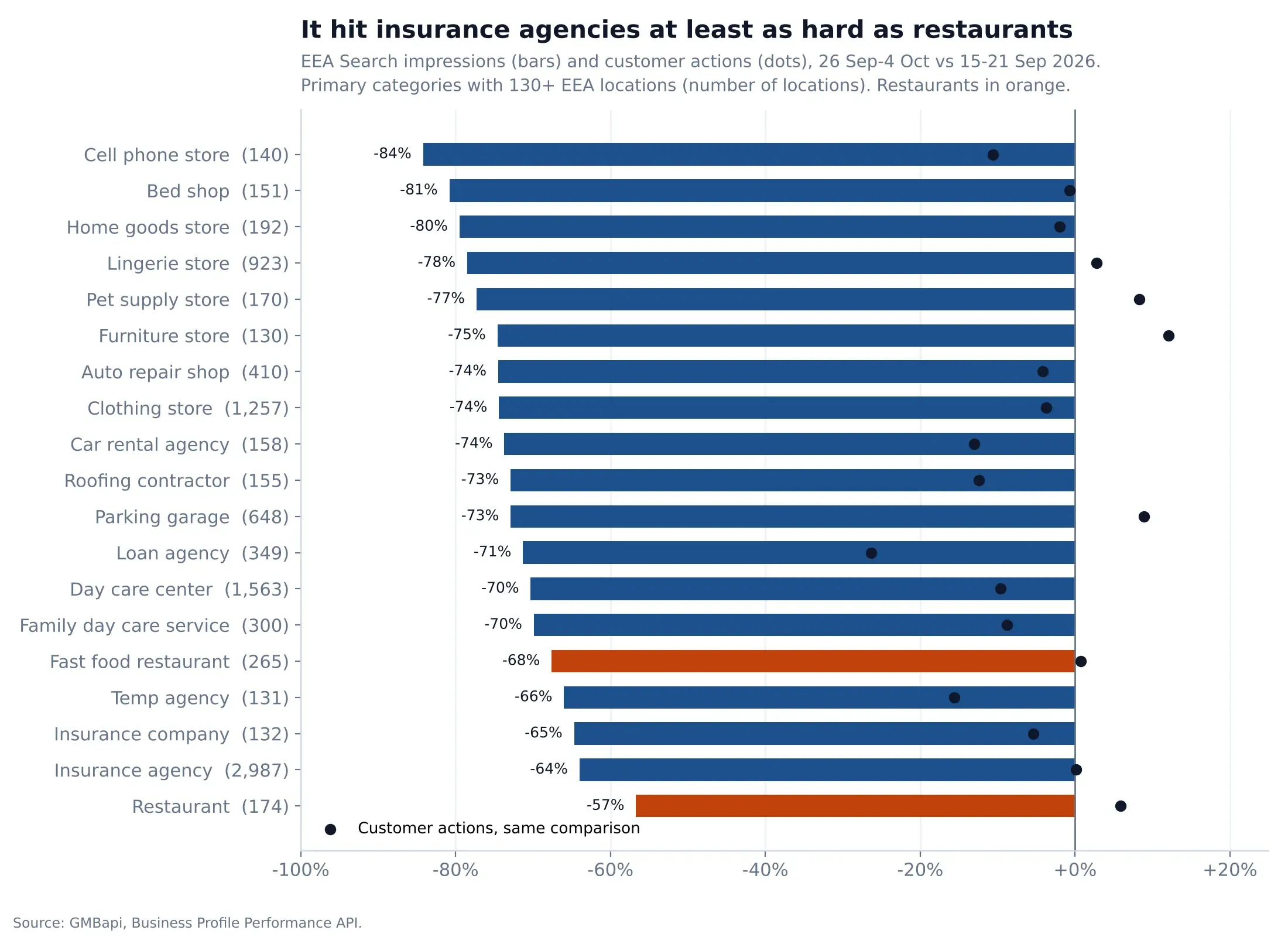
EEA Search impressions (bars) and customer actions (dots) by primary category, 26 Sep-4 Oct vs. 15-21 Sep 2026.
How to read it: Each bar is one business category, with the number of EEA locations in brackets. Orange bars are restaurants, a category where aggregator units do appear; blue bars are everything else. The bars are almost the same length from top to bottom, while the dots, customer actions, stay close to zero. The drop doesn't care what you sell.
Hotels Took Two Hits. Everyone Else Took One.
Hotels are the clearest test, because their aggregator unit went live first. Hotel Search impressions started falling right after the 8 September rollout and were down about 70% by 16 September, while every other category stayed flat. Then, on 23 September, hotels dropped again, together with everyone else. Hotel Maps impressions and hotel customer actions stayed flat through both drops.
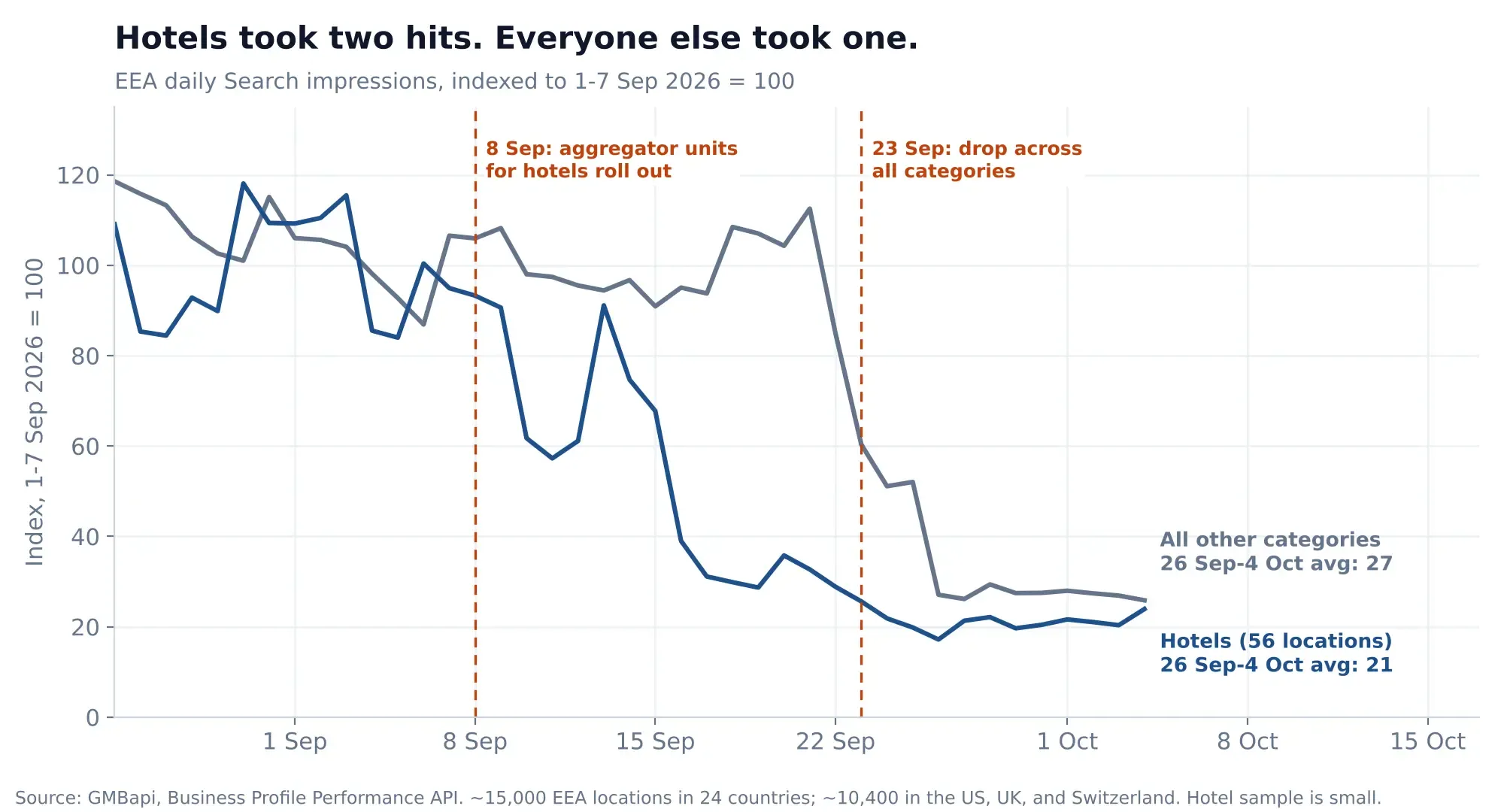
EEA daily Search impressions for hotels vs. all other categories, indexed to 1-7 Sep 2026 = 100.
How to read it: The blue hotel line breaks after the first dashed line, when hotel aggregator units rolled out, and settles around 30. The gray line, all other categories, stays flat until the second dashed line on 23 September. Then both fall. Two separate steps point to two separate changes: one tied to the aggregator unit, and one that hit every local business at once. The hotel sample is small, 56 locations, so treat it as a strong hint rather than proof.
What the Aggregator Unit Looks Like
The aggregator unit is real, and it changes what searchers see first. For "best pizza restaurant in den bosch", the Places section showed two providers stacked on top of each other: Thuisbezorgd/Just Eat and Google.
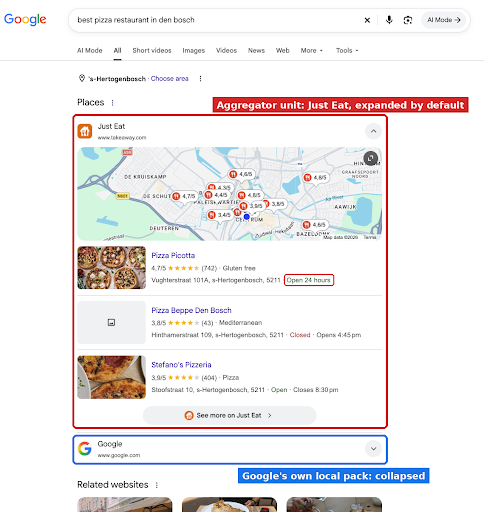
The Just Eat aggregator unit open by default, with Google's own local pack collapsed below it (12 October 2026).
How to read it: The red frame is the aggregator unit: Just Eat's map, Just Eat's ratings, and Just Eat's opening hours, with links tagged utm_campaign=aggregator_unit. The blue frame is Google's own local pack, the one built from Business Profiles, folded shut. Note the circled "Open 24 hours" for Pizza Picotta.
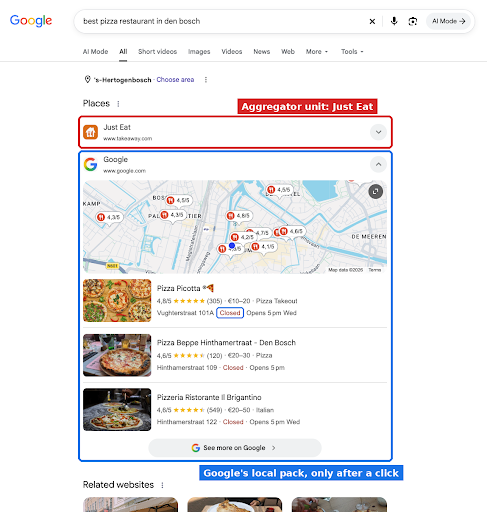
The same search with Google's section opened by the searcher.
How to read it: Here the Business Profile data shows up: Pizza Picotta is closed and opens at 5pm on Wednesday, the opposite of what Just Eat showed. Ratings differ too: 4.8 from 305 reviews on Google against 4.7 from 742 on Just Eat. When an aggregator opens first, its data is what searchers see first. By 13 October, Google was listed first and Thuisbezorgd second, so the order isn't fixed.
Hotels get the fullest version. In our check, six providers competed for the same spot:
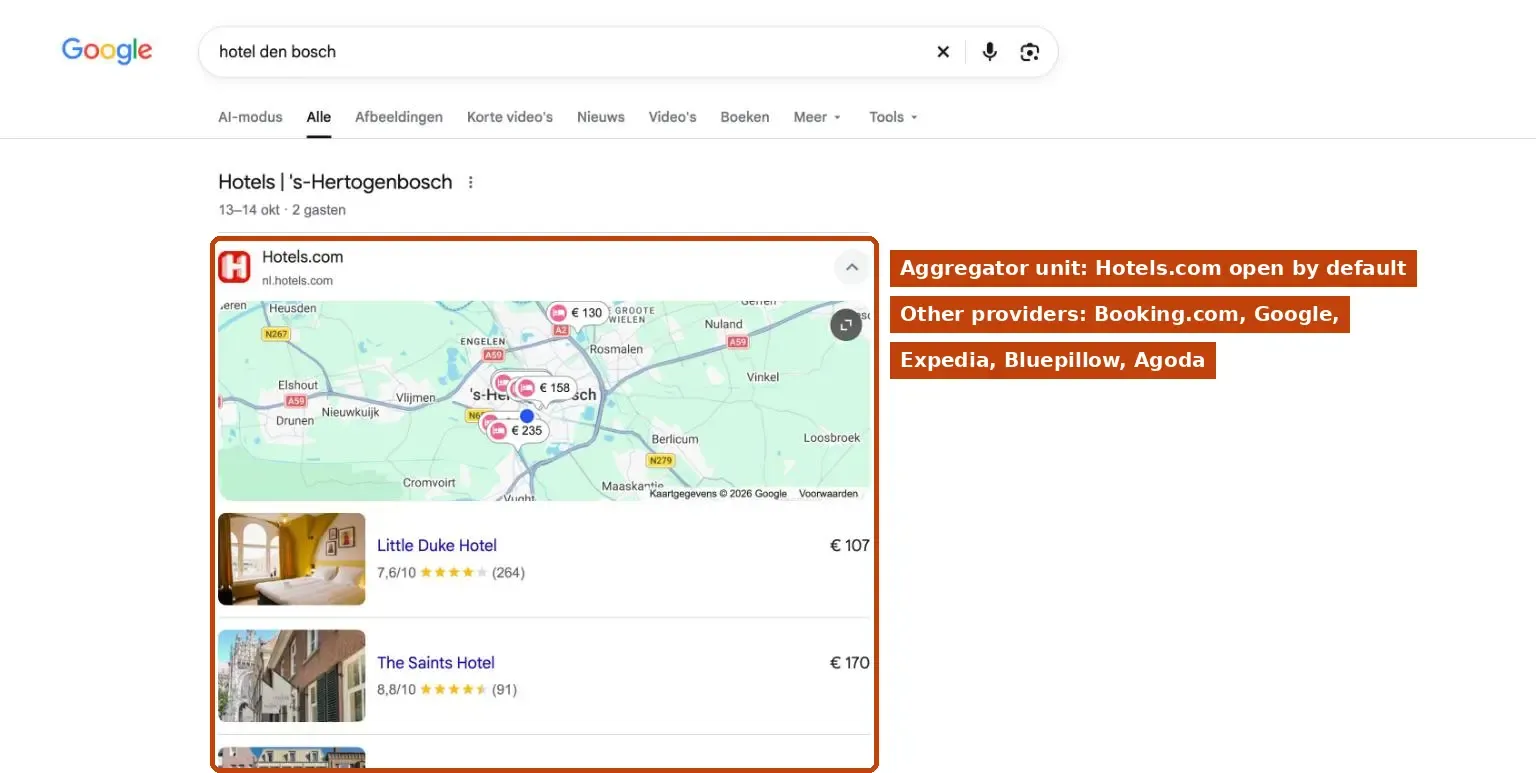
A hotel search in 's-Hertogenbosch with the aggregator unit, Hotels.com open by default (13 October 2026).
How to read it: The red frame is the full aggregator unit. Hotels.com opens first with its own map and prices; Booking.com, Google, Expedia, Bluepillow, and Agoda sit below it as tabs. Google's hotel results are now one option out of six.
Most Local Searches Have No Aggregator, but They Changed Too
The aggregator unit is one visible DMA change. It isn't the whole story. For insurance agents, day care, hairdressers, and even a plain "restaurant den bosch" search, we found no aggregator at all. What we did find is a new container: the local results now sit in a "Places" or "Businesses" block with a provider header that reads "Google, www.google.com", even when Google is the only provider.
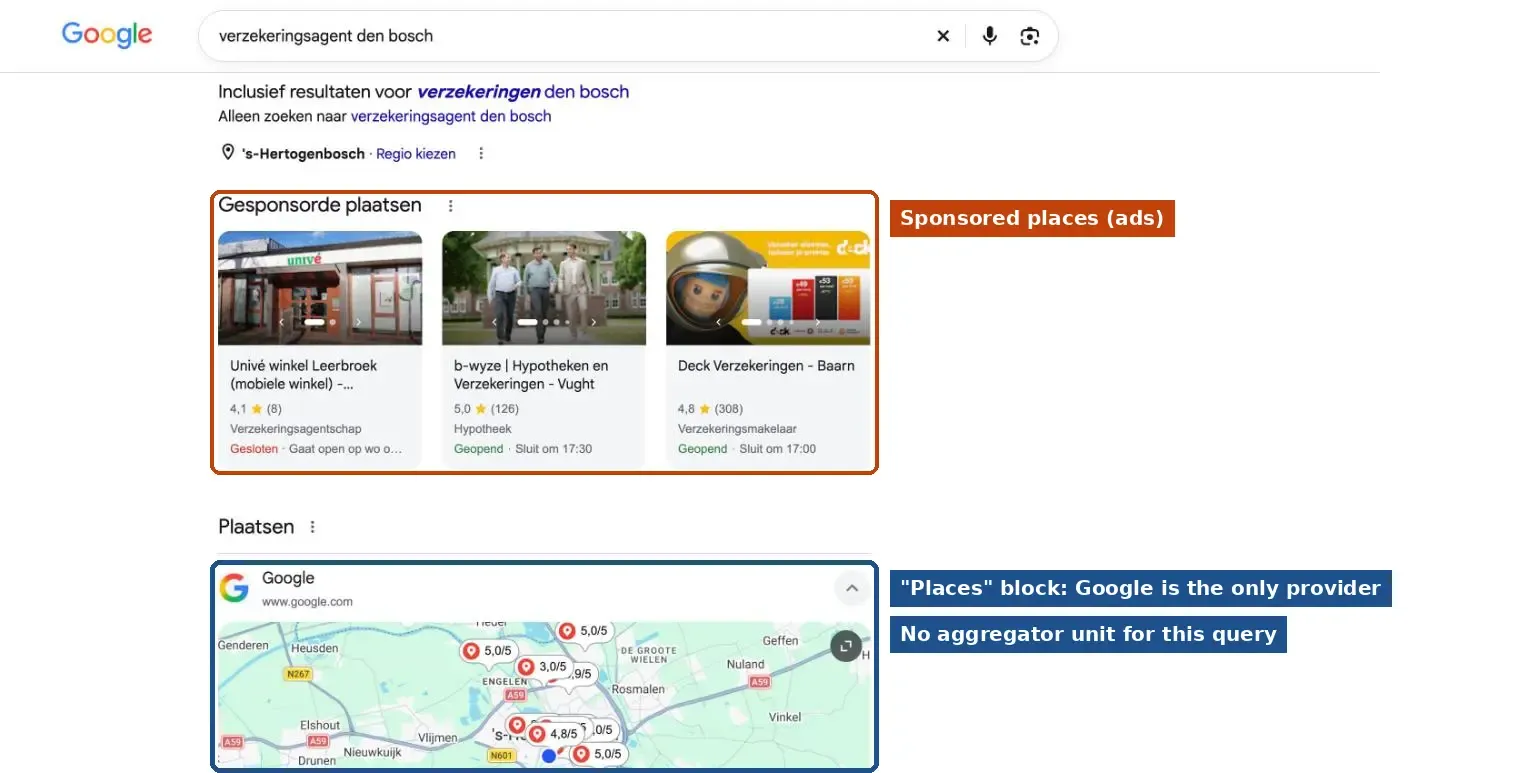
An insurance agent search in 's-Hertogenbosch: sponsored places on top, then a "Places" block with Google as the only provider (13 October 2026).
How to read it: The red frame shows paid "sponsored places". The blue frame is the organic local result, now wrapped in the same provider-style header used for aggregators, with Google as the only provider. No aggregator appears, yet this category lost 64% of its Search impressions.
Is This Also an Attribution Change?
It might be, and we're leaving that door open. Google's own API support suggested the pattern "may indicate a change in how impressions are being attributed between Google Search and Google Maps." The Maps half of that sentence doesn't match our data, because Maps stayed flat. The attribution half deserves a serious look.
Several things point toward a change in how Google counts or attributes Business Profile Search impressions, rather than a change in what searchers see:
- It hit categories without an aggregator unit just as hard. Insurance agencies, day care centers, and parking garages fell as much as pizzerias. A layout change limited to certain queries can't produce that.
- It happened on the same days everywhere. All 24 countries and all 36 large categories stepped down on 22 to 26 September, in the same rhythm.
- Hotels show two separate steps. The first lined up with the hotel aggregator rollout. The second arrived on 23 September with everyone else, as if something broader had switched on.
- Customers didn't change their behavior. Calls, website clicks, and direction requests held within a few percent, in every category.
- There is a precedent. In June 2025, Business Profile impressions dropped for many businesses while engagement stayed steady, and Google later acknowledged a reporting glitch.
If attribution did change, the lost impressions went somewhere the Performance API doesn't report, or they're no longer counted at all. One possible mechanism: since the redesign, Google's local results sit inside a provider-style container, even when Google is the only provider. If views of that block are no longer logged as Business Profile Search impressions, or are only logged when the Google section is opened, you'd get exactly this pattern: a uniform drop across every category, with customers behaving as before. That's our hypothesis, not a confirmed fact.
Two things would settle it: Google confirming what changed, or Google restating the historical data. Its support team told us it can't confirm either yet. Until then, a counting change and a display change remain possible, and the data fits a mix of both: a display change for hotels and some restaurant searches, and a broader counting change for everyone.
Who Pushed for These Changes, and Who Gains
The DMA's search rules came out of years of complaints from comparison and travel platforms. The Commission opened its Search proceedings against Google in March 2024 and doesn't name complainants in its July 2026 decision. The public pressure is on record, though:
- March 2026 letter: Eighteen organizations, including EU Travel Tech, the European consumer organization BEUC, several publisher associations, the European Tech Alliance, and the Initiative for Neutral Search, asked the Commission for a non-compliance decision, high fines, and periodic penalties.
- Travel platforms: EU Travel Tech, whose members include Booking Holdings, Expedia, Airbnb, GetYourGuide, Tripadvisor, and Skyscanner, welcomed the July fine. Booking is itself designated as a DMA gatekeeper since May 2024.
- Price comparison sites: Idealo, PriceRunner, Kelkoo, Foundem, and Trovaprezzi's owner Moltiply are pursuing damages in national courts over Google's earlier shopping case. A Berlin court awarded Idealo €465 million, and a Stockholm court ordered Google to pay PriceRunner about $1.97 billion.
The aggregator unit gives approved vertical search services the top spot. In our checks, that meant Hotels.com, Booking.com, Expedia, Agoda, Bluepillow, and Thuisbezorgd/Just Eat. We found no public record of Just Eat Takeaway complaining under the DMA. There's no public traffic data yet for the September 2026 changes. For the 2024 test, a Georgetown study found desktop organic traffic to flight comparison sites rose about 21%, with smaller platforms gaining most and the largest, such as Skyscanner and Booking, showing no significant change. Google says earlier DMA changes cut free direct booking traffic to European businesses by 30%.
Five Things to Do This Week
A reporting change is not a ranking loss. Treat it as a reporting problem first:
- Mark 22 to 26 September in every report. Annotate dashboards and client reports so nobody reads the drop as lost rankings or a broken profile. Hotels: mark 8 September too.
- Put customer actions next to impressions. Calls, website clicks, and direction requests, plus actions per 1,000 impressions, now tell you more than Search impressions alone.
- Stop year-over-year comparisons on EEA Search impressions. Compare against the weeks before 22 September instead, and compare Maps impressions only within 2026.
- Keep a non-EEA control group. If you manage UK, Swiss, or US locations, use them to separate EEA-specific changes from global ones.
- Fix your aggregator listings. Hours, menus, photos, and ratings on platforms like Thuisbezorgd, Booking.com, or Hotels.com are what searchers see first when an aggregator opens by default. Keep your Business Profile as the source of truth and copy from there.
GMBapi centralizes impressions, calls, website clicks, and direction requests across all your locations in one dashboard, with year-on-year comparisons and anomaly detection built in, so a break like 23 September shows up across every location at once. Our Local Rank Tracker, with free weekly or monthly Auto Tracking monitors, shows whether your Google Maps rankings actually moved or only the reporting around them did. And because we treat Google as the source of truth, the hours you set in your Business Profile are the ones we push out to the wider local ecosystem.
Conclusion
Three quarters of EEA Search impressions vanished in four days, in every market and every category, with or without an aggregator unit, while customers kept calling, clicking, and visiting. Report on actions, keep a control group, and keep your data identical everywhere Google might show it until Google explains what changed.
Sign Up Now: Start your free 14-day trial, no credit card needed
About the data
Source: GMBapi, Business Profile Performance API, daily data for 184 days (5 July to 4 October in 2025 and 2026), about 15,000 EEA locations in 24 countries and about 10,400 locations in the US, UK, and Switzerland. Changes compare daily averages per location for 26 September to 4 October against 15 to 21 September. Search results checked from 's-Hertogenbosch on 12 and 13 October 2026.
Sources
- European Commission: Commission fines Google €890 million for breaches of the DMA
- Search Engine Journal: Google adds local businesses to EEA search result units
- Search Engine Journal: Google rolls out redesigned search results across the EEA
- Google Search Central: Aggregator unit in Google Search
- PPC Land: 18 groups warn EU Commission to act on Google search non-compliance
- Skift: EU claims Google buries travel rivals in search
- Claims Journal: Google rivals line up seeking damages
- European Commission: Booking designated as gatekeeper
- Georgetown KGI: Who benefits from Google's SERP? The impact of the DMA
- Search Engine Land: Google AI Overviews jump from 26% to 80% of branded queries
- DAC: Drop in Google Business Profile impressions (2025)
- Anicca: Weekly search marketing update, 25 September 2026