Storage is a broad category. It covers everything from a house move needing a 200 sq ft unit to a traveller needing a locker for one backpack. Whether you run a national self-storage brand or a newsagent doubling as a parcel hub, your Google Business Profile is your digital storefront. It needs to do more than list an address. It needs to build trust before anyone walks in.
Choosing the right category
Google rewards specificity, and a generic "Business Centre" tag wastes that opportunity. Pick a primary category that reflects your main revenue driver, then use secondary categories to fill in the rest.
- Self-Storage Facility. For the larger operators: units, padlocks, and roll-up doors.
- Luggage Storage Service. Right for shops, cafes, or hotels offering a Stasher or Radical Storage-style service.
- Shipping and Mailing Service. The category for parcel drop-off and collection points.
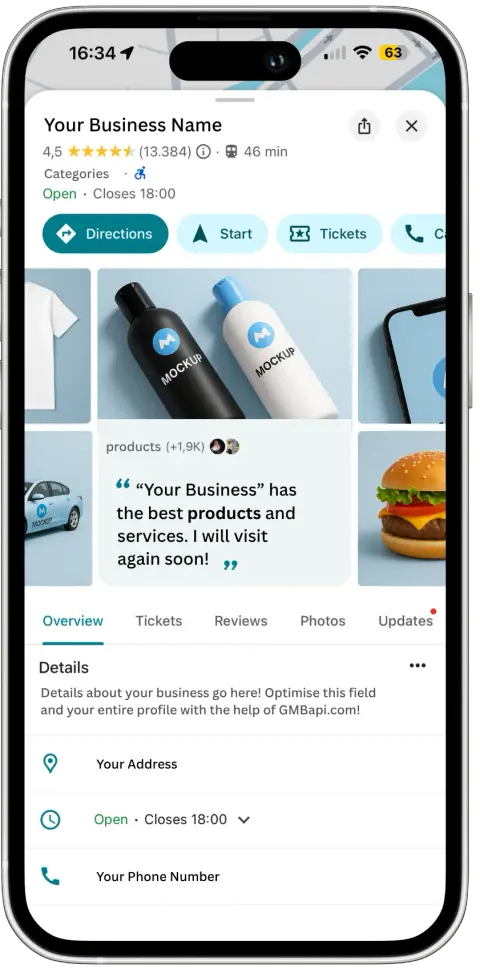
Retailers who add storage as a side service often make the same mistake: creating a second profile for it. Unless you have a genuinely separate entrance and separate branding, Google will likely flag that as a duplicate. Instead, add "Parcel Collection" or "Bag Drop" as custom services on your existing profile. High-quality photos of your secure storage area, or clear signage marking your parcel point, aren't optional. They tell a customer exactly what to expect before they arrive, and Google reads them the same way.
High-intent attributes and keywords
Storage customers care about two things above everything else: security and accessibility. If your profile doesn't state these explicitly, you're losing bookings to a competitor who does. Toggle attributes like 24-hour access, CCTV, and wheelchair accessibility, since these trigger Google's "near me now" filters directly.
Write your description around the actual searches customers run:
- The traveller. "Luggage storage near [station name]," "bag drop-off [city centre]," "secure suitcase storage."
- The parcel sender. "Parcel drop off point [postcode]," "package collection near me," "Amazon, DHL, or UPS pick-up point."
Google's proximity signal isn't purely GPS-based, it's landmark-based too. Mentioning your distance from a well-known museum or stadium helps Google's AI connect your location to the searches tourists are actually running. A tourist searching "luggage storage near [museum]" is far more likely to see you in the map pack if that landmark already appears in your description.
Best practices for storage providers
Feature | Why it matters | Pro Tip |
Photos | Customers are anxious about their belongings | Show the actual lockers. Bright, wide-angle shots prove the space is clean and dry |
Reviews | Reliability is everything in this category | Set up an automated review invite 24 hours after a customer drops off their bags |
Services menu | Tells Google exactly what you offer | Create specific services like "short-term luggage lockers" with clear pricing, "£5 per day" |
Google posts | Covers seasonal demand shifts | Use "What's New" posts for student summer storage or Christmas parcel deadlines |
Nobody searches for storage for fun. They need it because they're moving, travelling, or their hallway is overflowing with deliveries. Your profile needs to be the easy option. Vague directions or a phone number that goes nowhere sends that customer straight to the next pin on the map. In storage, the most accurate profile is usually the one that wins the booking.
Managing this across every location with GMBapi
Managing technical attributes and review responses across a multi-location storage network shouldn't be manual work. GMBapi.com keeps every unit and every locker visible, verified, and ranking across your entire network.
Start your free trial, or get in touch to see how it works for your locations.